Showing posts with label AncestryDNA. Show all posts

Sunday, August 7, 2022

My Ethnicity Results -- 2022


Two years ago I blogged about my ethnicity as predicted by five different DNA Labs: "Should we CELEBRATE genetic Ethnicity?" At the time I had "commissioned" Celebrate DNA to make me a tee shirt documenting these five results:


I decided to check each of these predictions today to see what changes, if any, had been made. 

Living DNA

  • Great Britain and Ireland  100 %  (last updated February 3, 2020).

FTDNA

  • Ireland 45%; 
  • England, Scotland and Wales trace.

Ancestry

23andMe

  • British and Irish 62.9%

 My Heritage:

  • English 53.1%
  • Irish, Scottish, and Welsh 5.5%

So, what should I wear to the next family reunion?


Thursday, September 13, 2018

New ways to look at your old DNA test results


Two announcements yesterday each give many of us something new to look at with some of our old DNA results. Both AncestryDNA and MyHeritage made important blog posts:


Transfers to MyHeritage:

MyHeritage tweeted that the company can now accept additional raw data transfers. However, note that there may be a real advantage in doing it before December 1st: 
We're excited to announce that we now support the upload of 23andMe v5 and Living DNA data files! Upload your DNA data now to receive DNA Matches and ethnicity estimates on MyHeritage for free. Read more: ht.ly/VP5630lNlya
The 23andMe v5 chip is the one the company has been using since the summer of 2017. This new conversion ability of MyHeritage will allow me to transfer kits of several of my family members who tested at 23andMe in the last two years. Previously, these kits could only be compared with other non-23andMe kits in the separate Genesis database at GEDmatch. 

Note that other newer entries to the DNA testing arena such as Living DNA also use this same chip and can be uploaded to use the diagnostic tools and matching database of MyHeritage that have become increasingly useful in the past year.


"Ancestry Unveils More Detailed and Precise Ethnicity Estimates"

The long anticipated update of the ethnicity estimates, at least for US customers were rolled out yesterday. This will give those of us who have tested at Ancestry something to ponder about. Chief Scientific officer Dr. Catherine Ball blogged:

Today, we announce that Ancestry will deliver ethnicity estimates with increased precision to its customers, through a new algorithm that analyzes longer segments of genetic information, marking an important evolution in the way we interpret DNA data. Having built and expanded our DNA reference panel, we have a better understanding of genetic signatures globally, can break down geographic ethnicity estimates with greater specificity and give you a more detailed picture of your origins.
Whether or not you agree that your new estimates more accurately describe your family's migration, they will give us much to discuss. Below is a summary of changes for my own estimates:

However, this summary does not tell me that some previous ethnicities dropped off completely in this upgrade. For me these were Caucasus 4%, Africa North 2% and Native American 1%. In neither version did Ancestry pick up on my known Finish ancestry which MyHeritage pegged at 2%. Sweden and Norway have not been called out in any of my other tests  They At least this gives me things to ponder.

What do you think about your new results?

Friday, September 30, 2016

From whom did Mary & Joy come?


Connect a septuagenarian with her half-sister for the first time and instantly she wants to know more about her ancestors -- particularly those on the sisters' shared paternal side of the family which was to be priority #1:


1. I would like to complete the maternal side of the Dodder family....
2. Then I would like you to investigate the Hessick side of the family.
3. Then I would like you to look at the Vosti family.
4. Finally, we’d like to research Bob’s family.
That was quite an agenda. I was willing to explore what might be involved with priority #1. As I did I noticed there were conflicting opinions as to the name of Mary's and Joy's paternal grandmother. In one source she was listed as Ida Dodder Grove. For short time I entertained the idea that she had remarried a Grove after her marriage to Charles Dodder had ended. That speculation was short lived. FamilySearch's cooperative and comprehensive Family Tree listed her as Ida Smith and assigned her a long multi-generational list of ancestors. But that Ida Smith was going to turn out to be born about a decade too early. Ida's true maiden name was literally chiseled in stone.


To investigate more deeply what the atDNA of Mary and Joy could tell us, I downloaded their raw results from AncestryDNA and uploaded them to GEDmatch. GEDmatch keeps operating on donations and does not charge membership subscriptions for most of its services including the ones I will be discussing here. Additional analysis tools are offered to those who donate to keep this volunteer site operating. I used the People who match both kits tool to narrow my focus to individuals to whom Mary and Joy both were related through their shared father. When I did so some familiar names began to emerge.

The 3rd, 5th, 9th and 18th highest matches on their combined list were known close cousins of mine. Bob is my maternal 2nd cousin. Doris, James and Mary S. are known maternal 1st cousins. Even I was a match but was way down the list. Isn't atDNA fickle? ;-)


name
Mary M
Joy

Bob
63.7
37.7

Doris
51.7
62.6

James
44.4
52.2

Mary S
31.7
38.7

Dave
12.0
33.5

Conclusion: The two half-sisters are related to my family on my maternal side. In addition, this relationship was through my maternal grandmother because of the strong match of my 2nd cousin Bob. Now we are making progress. But how far back was our connection?

To explore that question I ran a Generations analysis. The value shown is estimated generations to Most Recent Common Ancestor.(MRCA):

name
Mary M
Joy
Mary M
1.4
Joy
1.4
Doris
4.1
3.9
Dave
5.1
4.4
Mary S
4.4
4.3
James
4.2
4.1
Bob
3.9
4.3

Unsurprisingly the two half sisters showed up as about a generation and a half apart since they only share one parent. The rest of us showed up about 4 generations removed from the Most Recent Common Ancestor we shared with the half-sisters. Now we are getting someplace. We are looking for someone who is an ancestor of my maternal grandmother who is about 4 generations back. But we still have quite a way to go. 

My grandmother had a Cashatt father and a Grove mother. Where have we seen one of those names before? Can atDNA help us more? 

I do have a 3rd cousin who also has transferred her atDNA results to GEDmatch. She does not share my Cashatt ancestors but she does share the Grove line. Do her results help? Actually they do. She shares 32.2 cM with Joy and 15.3 with Mary. Apparently these just missed the threshold to be included in the test I ran above. She is predicted to be 4.4 generations removed from her common ancestor with Joy and 4.9 generations from Mary. This cousin shares Grove ancestors. I think we have a winner here. 

We still don't know how far back this connection is. To determine that I had to build back the pedigree tree of Ida. Remember her? After considerable research that included several marriage records, several census records, several vital records, etc. I was able to connect her back to my 3rd great-grandparents. I had been able to confirm my connection to them 11 years ago using both property records and tombstones as the remnants of Hurricane Katrina was bearing down on Ohio; but that is another story for another day. 

Below is a chart that connects me to my newly discovered 4th cousin half-sisters:  


One part of the mystery of from whom did Mary and Joy come has been solved.


Saturday, September 24, 2016

Finding Joy


It was the third full day of Olympic competition in Rio. In the pool Ryan Murphy had just collected a gold medal for the US in the 100 meter backstroke. Michael Phelps swam semis of 200 meter butterfly. Keri Walsh Jennings & April Ross had convincingly defeated the Chinese team of Wang & Yue 21-16, 21-9 on the beach. Although there was more competition on TV, I had had enough for the night and headed to bed. However, I walked past my computer and felt compelled to check my email.

There was an incoming message from a former colleague in California. I had renewed my acquaintance with Mary during a chance encounter in June at a restaurant in Morro Bay, CA, where we were having lunch with several friends and former neighbors. She walked in to the restaurant with a former genealogy client of mine and we got to chatting about using DNA in family history research. I had previously made a cameo appearance in her journalism class to discuss two aspects of intellectual property that I covered in my course “Ethics in the Information Age” – copyright and plagiarism.
Mary’s email said in part:
I bought your books and am reading and learning as fast as I can, but I don’t think I can find my sister in less than a year. You are so incredibly fast at this relative hunting do you think you can find her for me? I would be happy to pay for your time but it would never be enough.   She is probably 80 by now so time is critical.
Thanks for considering my proposal. I’ve visited more than 90 countries and now I’d just like to talk about the dad she never knew with this half sister. Her family never approved of my dad, the creative inventor, so pushed him away after only a year. Her name is Joy by the way.
I made sure I had the codes to access Mary’s recent DNA test results and went on to bed.

The search turned out to be easier than any of us expected. By the time Mary got up and checked her email the next morning, there was a message asking her to call me AND there were two pictures of Joy waiting in her email box. 


Before noon Nashville time Mary had used one of the phone numbers I had given her to reach Joy and they had talked on the phone for more than an hour and a half. This was to be the first of many, almost daily calls that have followed.

It is rarely this easy. Two years earlier when I had unexpectedly gotten an unknown 1st cousin DNA match, it had taken over seven months to figure out which sibling of one of my parents was responsible for my newly discovered cousin Jim being on this earth. That tale has previously been chronicled in this blog. As difficult as Jim’s search had been, even Jim’s search was easier than many.

Joy was literally just sitting there waiting to be found. She had positioned herself well. Both she and Mary had tested at AncestryDNA. Joy appeared on Mary's match list:


1,857 cM of shared DNA is far too much for a normal 1st cousin match. This almost certainly had to be the half-sister Mary was seeking. All that remained was to locate her.

I immediately left a message for this match in Ancestry’s proprietary process of contacting other members. However, because years of experience have taught me that this indirect method of contact is slow at best and often ineffective. It values the privacy of the matches over efficiency of making contact. It also does not always notify the match that a message is waiting online – particularly if the match has not maintained an ongoing Ancestry subscription.

Fortunately, in this case Joy had not made a serious effort to hide her identity. I was later to find out that she also had been searching for her half-sister off and on for a decade but there are lots of women named Mary out there.

Joy’s Ancestry login was a combination of her initials and married name --not so good for privacy but great for leaving bread crumbs for matches to follow. Joy had posted a brief pedigree chart on Ancestry which listed her as “Private” but outed her husband and included a picture of him. After searching several online directories of living people I found a recent address in Texas and three phone numbers listed in The U.S. Public Records Index. I was able to find accounts for Joy on LinkedIn and Facebook. While exploring LinkedIn, I got a popup suggestion of a person who might be able to introduce us. That person was a person very active in helping adoptees find their birth families. This led me to believe that Joy might be actively seeking her biological relatives – an assumption that turned out to be only partly correct. The pictures on Facebook matched the handsome fellow attached to Joy’s pedigree chart on Ancestry. 

This search was a little more complicated than that but not much. I’ll probably never have an easier case than this. 

Mary sent me a check with a generous tip added; but I’ll always treasure what was written in the memo section of the check more than the money. It said, “For Great Joy".

A big uniting event is planned for early November in Texas. Pictures to follow.

Dr. D. made another interesting find as he located the missing half-sister. It connects him to the sisters; but that is another story for another day -- sometime very soon.     

Thursday, April 21, 2016

DNA Day Sales & a Birthday Party


Many of you know that we celebrate DNA Day on April 25th to commemorate the 63rd anniversary of the publication of the Nature article that detailed the structure of DNA. It's a little late to enter ASHG's DNA Day essay contest this year, but you still may want to contemplate your own response to the assigned topic. Read the next paragraph before you guess what my position might be. 

A few of you may know that this day has a special significance for the Dowells of Nashville. It will be the 2nd birthday of our 2014 DNA Day miracle. Benjamin was born 9 months AFTER he had part of his DNA screened to select a healthy fertilized egg that did not contain his mother's heritable mutated and potentially deadly Brugada gene.


DNA SALES!!!

To help us celebrate Benjamin's 2nd birthday this weekend, at least two of the big three US DNA labs are having sales from now until April 26th.


1. Last night CeCe Moore spread the word about the DNA Day sale at AncestryDNA 
- $79 and free shipping if you use the FREESHIPDNA code -
DNA.ANCESTRY.COM


2. 10 AM Central time today is the kickoff of a big DNA Weekend sale at Family Tree DNA


Ancestry's sale price is for the only product in the company's line of DNA tests. FTDNA's sale includes many but not all of the company's tests -- some of them discounted more than they often are during sales. 

I'm going to a 2 year old's birthday party this weekend dressed as -- (did you guess it?) -- a carnival barker.

So come one, come all and let the spitting and swabbing begin!! 


Friday, April 3, 2015

Does Ancestry think we are NOT OK?


I find Ancestry's DNA Circles intriguing and really enjoy seeing a green leaf match on my DNA results page. However, I do object to Ancestry's patronizing attitude toward its customer base. "Trust me" is not an endearing phrase when uttered by a used car salesman. That kind of response is no more endearing when it comes from a lab you have paid to analyze your DNA. Yet "trust me" is exactly what we are asked to do when Ancestry announces we have a DNA match.


We are told that Ancestry has "Confidence Extremely High" that they have identified a 1st to 2nd cousin (see above) but we have to take that on faith. We cannot see the total number of cMs that match with this alleged relative or the length or location of our longest matching segment. Ancestry does not think customers who paid for the test need this information. It would be nice to see if others match us on exactly that same segment but Ancestry does not want to confuse us with that information. After all the company seems to say, wouldn't customer supplied pedigree charts be a better way to document matches with our relatives than would be precise chromosome locations? :-(

Why does it have to be either/or? Lots of us in the customer base would like to have both! It would simultaneously give us more value and give Ancestry more credibility.

For the last 15 years direct-to-customer (DTC) genetic testing for genealogical information has gradually been emerging from the chilling paternalistic concerns of the medical establishment about letting civilians have direct access to our own genetic data. This information is taken from with the cells in our own bodies. We have been making progress on a number of fronts -- including US Supreme Court decisions that corporations cannot patent natural genes. Now in the last three years Ancestry is trying to exert a paternalism of its own over access to our personal genetic information. 

Many of you remember the 1969 bestseller I'm OK You're OK.


It was based on the Transaction Analysis model of Eric Berne. You may remember that we were trained to analyze communication transactions using diagrams similar to the one below. It seems clear to me that Ancestry sees transactions with customers as them (the Parent) giving us (the Child) the information they think we need and are able to handle without us asking too many hard questions that might overload tech support about it.


If this analysis of our communication pattern with AncestryDNA is correct, Ancestry sees it as Ancestry is OK but we the customers are NOT OK. This seems to be in direct contrast to Anne Wojcicki's stated goal for 23andMe to empower us by providing us with access to our own genetic information and thereby change the face of health care. 


As rumors are beginning to fly that Ancestry is exploring the possibility of providing health related information from our DNA, I wonder what the business model would be for such an endeavor.

Tuesday, January 27, 2015

Did AncestryDNA quietly become more expensive?


Many of us die hard genetic genealogists who are seriously addicted to family history research may not have noticed, but AncestryDNA seems to have become more expensive for the casual DNA test taker. In a notice last updated on January 12th in the Help section of its site, Ancestry differentiated what is available to those who order an autosomal DNA (atDNA) test and those who order an atDNA test AND a database subscription. 

For those of us who regularly research family history, we subscribe to Ancestry.com for the billions of records in historical databases. If we throw in an atDNA test; we get the full matching information at no extra charge except for the modest, one-time, cost of the test (currently $99). However, the current pricing structure as described above, makes one wonder if the price of the test is considered to be a loss leader to sell subscriptions to databases. If so it is understandable why Ancestry often offers the test at flash sale prices of $89, $69 and even $49.

Many of you will remember that Ancestry announced last summer that it was no longer testing yDNA and mtDNA. They really had not been active in this marketplace for some time when this announcement was made. 

What then do persons get if they do not also subscribe to the databases? Ancestry says:


An AncestryDNA test without an Ancestry subscription includes:

§     One of the most technologically advanced autosomal DNA tests available, that looks at over 700,000 markers across your entire genome.
  §     You’ll have access to your personal online DNA results, on Ancestry.com at all times.
  §     Your DNA results include your full genetic ethnicity breakdown. So for instance, you can quickly discover if you’re part Scandinavian, North African, European Jewish—AncestryDNA reports on 26 different regions from around the world.
  §     Receive updates to your ethnicity over time as we roll out new findings.
  §     Your DNA results also include a dynamic list of DNA member matches to help you find potential new relatives. This is continually updated and includes everything from immediate and close family to 4th-5th cousins.
  §     Manage multiple AncestryDNA tests in one account.
  §     Keep your DNA results stored securely with your family history research on Ancestry.com, all in one place.
The first four items above have to do with ethnicity testing. This would seem to be the main benefit for someone who tests but does not want to subscribe to database access. This is a prime motivation for many people to test. It swells the size of the database of tested individuals and provides more matches for all of us. 

For those of us who consider ourselves to be serious genetic genealogists, the ethnicity results are the softest part of the "science" of DNA testing for family history. The accuracy of the DNA testing is not in question. However, our knowledge of the GPS locations of specific populations 500 to a 1,000 or more years ago is far from settled science. 

Hard core genetic genealogists are after the matching relatives. We are also interested in the details of how and where theses matches occur. We have been frustrated by Ancestry's unwillingness to provide such details since it got into atDNA testing almost three years ago. It does not look like relief is on the way. 

It is unclear to Dr. D what exactly customers are being offered in the 5th bulleted item above:
 §     Your DNA results also include a dynamic list of DNA member matches to help you find potential new relatives. This is continually updated and includes everything from immediate and close family to 4th-5th cousins.
It appears that the list of close matches will be updated and continue to be available even if one does not opt to subscribe to Ancestry's database. What is not clear is whether such individuals will be able to see the pedigree charts of those matches. Without the pedigree charts, such matches are essentially useless genealogically speaking.

I hope someone from Ancestry will be able to clear this up for us. 

Tuesday, November 25, 2014

FTDNA's Holiday Sale Adds Mystery Rewards


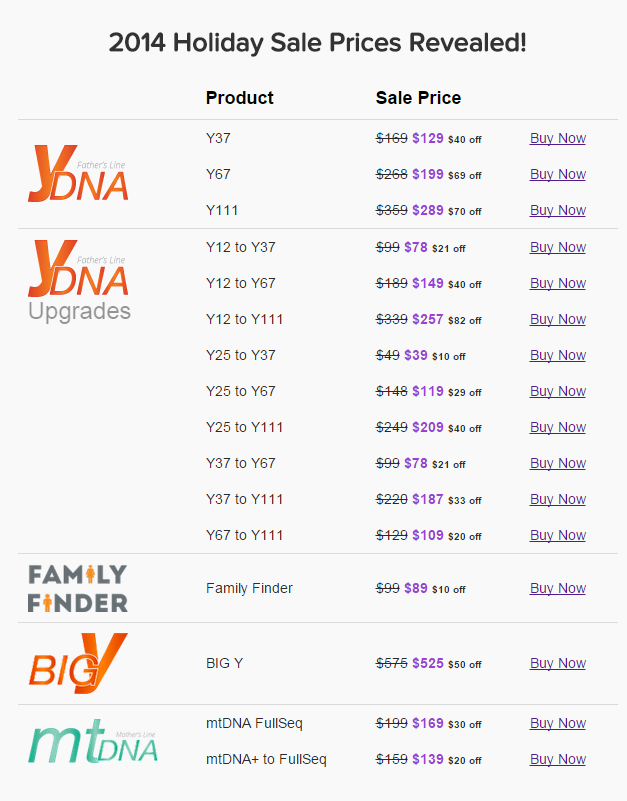
This morning the 2014 Holiday Sale is being unveiled on the FTDNA site. Everyone likes a sale; and this is a very comprehensive one -- with a twist thrown in to add to the excitement. Below is what the company has to say:


 We’re launching the long-awaited Holiday Sale and we wanted you to be the first to know! It will extend through Dec. 31, 2014 (11:59 PM Central). The reduced prices will either be visible at 10:00 AM Central or very shortly afterwards.
 For this holiday season we’ve got an exciting new twist to the sale - Mystery Reward discounts! The Mystery Reward will be a randomized discount (up to $100 off) that can be applied on top of the already reduced Holiday Sale prices.  
The Mystery Reward icon will appear on testers’ myFTDNA dashboard each week and the code will expire the night before the next Mystery Reward appearsWhen you click the icon, you'll to go to the reward page to open the Mystery Reward for savings up to $100. We’ll also send an email notification to the kit’s primary email address when a new code is available for use or sharing.   Best of all, there will be a new Mystery Reward every week. Customers can use the discount or can share it with a friend.     In addition, all customers who have purchased the Big Y test will receive a coupon for $50 off a Big Y test.


That's ON TOP of the sale price. Yes, you read that right. A coupon that can be used on top of a sale price. The coupon can also be "regifted," meaning shared with a friend or fellow project member. 
   Here are the prices:


Dr. D wonders if 23andMe and Ancestry will follow with offers of their own? They are really only in competition on FTDNA's Family Finder test. Neither 23andMe or Ancestry offer yDNA or mtDNA testing. Rumor has it that Ancestry may offer something on Black Friday.

Wednesday, April 23, 2014

Sales on DNA Tests


Several companies that test DNA for genealogical purposes are currently offering sales or will be by this weekend.


atDNA Tests

23andMe is currently offering 20% discounts on ADDITIONAL kits after the first when multiple kits are ordered at the same time. This sale is good for those who wish to test several family members. This is an atDNA test.

AncestryDNA is offering a Mothers' Day Sale. It may be a little hard to find but clicking on the link in this paragraph should get you there. It is not clear how long the sale price of $89 will be available for this atDNA test. Buyers are told if they order before May 1st, the kit should be delivered by Mothers' Day.


yDNA Tests

FTDNA is offering two separate sales for a tightly defined period. The sale begins at 12:01 AM CDT on DNA Day, Friday April 25th and ends on 11:59 PM on April 29th. Y-DNA SNPs will be 20% off from April 25 - 29. In addition, the Y-DNA 37 test will be 20% off the retail price. As usual with kits ordered from FTDNA, you may qualify for additional discounts by ordering through a surname or geographic project. Please note that there are two separate tests here. Because these two tests are aimed at different audiences, it is likely that one customer will not be ordering both at the same time. The yDNA 37 STR marker test is a good entry level test for men. It is to test the paternal line which usually corresponds with the surname. On the other hand the individual SNP tests are for more advanced testers who already have some idea about their deep ancestry haplogroup and want to define it more precisely.

YSEQ is also offering individual SNP tests in direct competition with the sale of such tests at FTDNA. Again let me remind you that these tests are not generally for beginners to genetic genealogy testing. The price of $25 per marker "will be in effect until (including) Father's Day (June 15th 2014)."  Thomas & and Astrid Krahn, formerly yDNA experts at FTDNA, are the principals in YSEQ. This price is cheaper per SNP than the sale price of FTDNA. Free shipping is offered on orders of 4 SNPs or more. Buyers will have to consider whether the cost and time of securing new saliva samples for YSEG will offset the difference in the SNP prices. For unusual SNPs one, both or neither lab may currently offer the desired test. There is no simple single solution that will be the best choice for everyone. 


So we have two sales for atDNA, two for yDNA SNPs and one for yDNA STRs. Have fun and enjoy the sales. 

Sunday, June 30, 2013

Which Autosomal DNA Test Should You Take?


The DNA testing marketplace continues to evolve rapidly. What would cost about $400 just 3 years ago can now be purchased for about $99. It is hard to imagine that this level of price cutting can continue. But wouldn't it be nice for us DNA junkies if they could? Not only could we take more tests. Many more potential cousins would add their information to DNA databases.

Until FTDNA's just announced Sizzling Summer Sale, it was cheaper to take 23andMe's test at $99 and then transfer your downloaded raw data to FTDNA at $69 than it was to pay full $289 for Family Finder. Now that FTDNA has (at least for the next few weeks) reduced Family Finder to $99 this economic incentive may not be as strong. However, starting with 23andMe and transferring your data allows you to fish in both databases for cousins. It also allows you to take advantage of the analytical tools of both companies AND the health related information of 23andMe. FTDNA allows 3rd party transfer from Ancestry's autosomal data as well.

However, FTDNA is the only company that accepts raw data from another lab test. It also is the only one that is now storing DNA samples for future testing. This can only be taken advantage of if FTDNA was the original tester of your sample. This is particularly important when the person being tested is elderly so that their sample is available for tests that may become available in the future. 


When you are on a limited budget, you need to weigh what you may learn from further analyzing your own genome vs what you potentially could learn from testing another family member. Y-DNA testing of a sibling (male) will generally give identical results as those of the first brother tested. With mitochondrial DNA testing this is true for siblings of both sexes. However, with autosomal DNA testing sibling testing does not give identical or near identical results. In general siblings share about 50% of their autosomal DNA. However, they can range from as low as 37% to as much as 63%. This is not critical if one is trying to match 2nd cousins or closer relatives. It does start to matter when one is seeking to find 3rd cousins or more distant relatives.

When fishing for cousins in any company's database, you and any of your siblings will be almost certain (more that a 99% chance) to match a 2nd cousin. At the 3rd cousin level your chances (and those of a sibling) for matching someone in a given database are about 90%. At this level of cousinhood it is still likely that you will be matching most of the same individuals that your siblings match. However, at the 4th cousin level, you and each of your siblings will have only about a 50% chance of matching a particular individual in the database who is in fact a cousin. Your match list and those of your sibling(s) will start to vary considerably. At the 5th cousin level and more distant very significantly. Each of you will match with about 10% to 15% of your actual cousins in the database but many of them will be different individuals. Beyond 5th cousins you will still get lots of matches because you have so many cousins at this level. However, you (and a sibling) will each have a less that 2% chance of matching a particular cousin in a database. 

Since the matching efficiency declines down this slippery slope with each generation, it is important to test the oldest possible member of your family for best autosomal results. This is only marginally true with Y-chromosome or mitochondrial DNA testing.

All of this is important to keep in mind when you are allocating your limited dollars and deciding which test to take AND which family member to test. 23andMe currently offers $20 off additional test kits when they are ordered at the same time. 

Happy testing and may you find lots of new cousins!