Showing posts with label ySTR. Show all posts

Monday, August 1, 2022

DNA Testing your DESCENDENTS with BIG Y 700--Part 2


Earlier this year I published a post that is part 1 of this post. In that I described testing my grandson and a couple of questions it raised.

  1. Did the one mutated ySTR between me and my grandson occur when my son was conceived or when my grandson was conceived?
  2. Will my son's terminal ySNP cover my grandson's "private variant" or is that variant the unique marker for my grandson? 

Now my son's test results are back and I have the answers to those questions and more! 
  1. My son and I are 111/111 marker exact ySTR matches so my grandson is the mutant. The mutation between me and my grandson that I reported in my previous post was formed when my grandson was conceived.
  2. My son's terminal ySNP does cover my grandson's "private variant". As of now neither of them are shown to have any private variants.
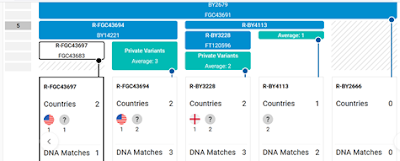
More exciting to me is that my son and grandson share a terminal ySNP, R-FTC50269, that I do not share. It appears to have been formed when my son was conceived in 1969. All patrilineal descendants of my son--and therefore of me--will forever carry this ySNP. FTDNA's new beta version of their Discovery tool illustrates this ySNP:


Your Y-DNA Haplogroup Report for R-FTC50269

The Y chromosome is passed on from father to son, remaining mostly unaltered from generation to generation, except for small trackable changes from time to time. By comparing these small differences in high-coverage test results, we can reconstruct a large Family Tree of Mankind where all Y chromosomes go back to a single common ancestor who lived hundreds of thousands of years ago. This tree allows us to explore paternal lineages through time and place and to uncover the modern history of your direct paternal surname line and the ancient history of your ancestors.


R-FTC50269

Haplogroup R-FTC50269 represents a man who is estimated to have been born around 50 years ago, plus or minus 100 years.

That corresponds to about 2000 CE with a 95% probability he was born between 1885 and 1998 CE.

R-FTC50269's paternal lineage branched off from R-FGC43697 and the rest of mankind about 100 years ago, plus or minus 50 years.

He is the most recent paternal line ancestor of all members of this group.

There are 2 DNA test-confirmed descendants, and they have specified that their direct paternal origins are from United States.

As more people test, the history of this genetic lineage might be further refined.


For more information about this ySNP click here.


It looks like testing the younger generation has given me a genetic coat of arms!


Tuesday, March 15, 2022

DNA Testing your descendants with BIG Y


Those of us who are veterans of atDNA testing have long preached "test the oldest generation of the family." For atDNA testing this is still great advice. However, there may be times when we can learn from testing the youngest generation.

I know that there are various schools of thought about how old a child should be before they are tested. That topic is an important one which I will not deal with here. I have long tested family members of all ages. By so doing I discovered several years ago that grandchildren do not inherit exactly one-fourth of their atDNA from each grandparent. You can see my blog post about that (I got it wrong).

More recently I bought a BIG Y 700 test for my oldest grandson. Until now ySTR tests have primarily been to find matches among other test-takers. ySNP tests have been primarily to discover new branching points along the Y chromosome since possibly sixteen million or more locations can be explored. As his results have come back, I have so far learned two things: 

  1. Either my grandson or his father is a "mutant." My grandson matches me on 110 of the first 111 markers over which FTDNA tests ySTRs. In one of the two conception events a mismatch occurred. 
  2. Prior to my grandson's test results, I had two "private variants" not found in the genome of any man previously tested. Now both of those variants are shown in the box with the white background in the column on the left below. Now that two men have had those ySNPs show up in their tests, they have become "named SNPs" and added to the BIG Y Tree, In addition my grandson's test results had identified a new "private variant" which had not previously been discovered.    


So what if anything have I learned about my family history by testing my grandson? In the test of his first 111 ySTR markers, we had one mismatch. This allows FTDNA's YDNA TiP tool to predict that we have a 78% chance of sharing a common patrilineal ancestor within 2 generations. (The correct answer.) The TiP tool predicts we have a 95 percent chance of sharing that common ancestor within 4 generations. He is not my closest match over the first 111 ySTR markers. I have one cousin who is an exact match over those markers. However, that cousin shares 6 Big Y STR differences with me when all 590 STRs tested are considered. My grandson shares only 2 STR differences with me over all STRs 659 tested. Since ySTRs can mutate at random, when more are tested the results are more accurate. The results confirm that he is in fact probably relate to me within two generations along my patrilineal line.

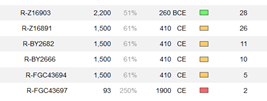
The two ySNPs in the white box above, R-FGC43697 and R-FGC43683 are equivalent SNPs for genealogical purposes at least for now. We really can't tell which occurred first. What these designations tell us is that these SNPs are part of the R1b male haplogroup and they are #43,683 and #43,697 of the ySNPs discovered by and named by the Full Genome Corporation lab. Other than that these numbers have no significance. For now my grandson and I are the only two men who have mutations at these locations. We would expect any of our male descendants to inherit them. They would become a sort of genetic signature of our particular family line of descent--our genetic coat of arms. Early indications are that these mutations may have occurred about a hundred years ago. More testing by family members will be needed to learn more specifically when they may first have occurred. Below is a timeline chart generated by Rob Spencer's Tracking Back tools:

This suggests that ySNP R-FGC43697 may have been created by a mutation in a birth event occurring around the beginning of the 20th century. Also note that my previous haplogroup assignment of FGC43694 as well as other nearby cousins like all of us under ySNP R-BY2666 appear to be connecting back as far as 1,500 years ago. Several SNPs back then have yet to be separated out time wise.  

The results of my grandson's test have pushed my own terminal ySNP down into genealogical time--perhaps to the last two or three generations. This has caused us to order a BIG Y 700 test for my son. That may be overkill. I would have considered it to be a few months ago. However, it will show us a couple of things at the very least.

  1. Did the one mutated ySTR between me and my grandson occur when my son was conceived or when my grandson was conceived?
  2. Will my son's terminal ySNP cover my grandson's "private variant" or is that variant the unique marker for my grandson?

It is an expensive way to add these two bits of information to our family history but I could plan a genealogical research trip that could cost more that the test with less guarantee of new information.


Saturday, March 5, 2016

SNP Tsunami Continues Into Third Year


Many of us spend a great deal of time, energy and money attempting to document that a particular ancestor of ours belonged to a particular tribe or ethnic group. We all get very excited when we find a family Bible or a diary of an ancestor that dates back two or three hundred years.

Don’t you wish your ancestors had carried a passport which got stamped at every branching point of their intercontinental migration route as they trudged through prehistory? Actually they did. In some cases our genomes have recorded more than a hundred thousand years of travel.

This travel is documented in the mitochondrial DNA of all of us. A separate and more detailed path is documented in the yDNA of men. Many call this anthropology. In Chapter 6 of my most recent book, NextGen Genealogy: The DNA Connection, I call this extreme genealogy. In either case it is the study of haplogroups – or the ancient clans to which our ancestors belonged.

Women ancestors were somewhat limited in what they could communicate to distant descendants because our mitochondrial DNA (mtDNA) contains only 16,569 locations in which they can record the presence of one of the four chemical bases that make up our DNA. Their paths through prehistory can be traced for our female lines using mtDNA test results. mtDNA was the basis for Bryan Sykes’ pioneering Seven Daughters of Eve.

Our men ancestors had tens of millions of additional locations where such information could be logged. What we look for today is where on our genomes these ySNPs occurred in this transcribed travel record. Once such a permanent change has occurred, it is passed down to all male descendants.

What are ySNPs and how do they differ from the ySTRs we have been testing since 2000?


Short Tandem Repeat (STR)
Pronounced "stir." This is a repeating pattern of genetic code letters at a location on the genome. The value is the number of times that pattern is repeated at that location.
Single Nucleotide Polymorphism (SNP)
Pronounced "snip." A single and permanent change in the DNA bases at a given location.

Consumer DNA testing to discover family history information began in 2000 with the focus on the Y chromosome (yDNA) which only males possess. Mitochondrial DNA testing for both genders soon followed but is somewhat limited because it has ONLY 16,569 locations to store a single bit of information. By 2010 autosomal DNA testing burst on to the scene and has become the most popular test.

By 2013 a new testing cycle for yDNA became available to genealogists. While the previous cycle had focused on testing ySTRs, the new wave examines ySNPs.

However, yDNA can record 3,500 times the data that mtDNA can. Therefore, it has the power to record a much more detailed migratory history.
Most of yDNA testing to date has been conducted on Short Tandem Repeats (ySTRs). When we talk about 12, 25, 37, 67 and 111 marker tests, we are referring to how many ySTRs were tested. STR testing is analogous to dispatching a census taker to a village which is known to have 12, 25… residences. In our scenario the locations of these residences have been defined by geneticists as being accessible and having a rate of mutation that is somewhat predictable. At each location our census taker records how many STRs are currently in residence.

In NextGen testing the focus shifts to Single Nucleotide Polymorphisms (SNPs). Instead of dispatching probes to specific, predefined locations, NextGen ySNP testing is more analogous to take satellite images along the entire Y-chromosome. Although the chromosome contains almost sixty million identifiable locations, current technology allows us to get reliable data from only about a fourth of those locations. Still this is an overwhelming amount of data. The computing power to analyze it has only recently become available.

At present ySNP chasing is only in its infancy. A vast majority of the SNPs we know today have been discovered in the last two years. The statistics in the chart below represent the number that had been placed on the International Society of Genetic Genealogists (ISOGG) yTree committee chaired by Alice Fairhurst:

Cumulative SNPs placed on the ISOGG yTree

Another way to look at this SNP tsunami is to view the new SNPs identified in a two year period (2013-2015) for R1b-L21, the most common male haplogroup in Western Europe today:

Known SNPs in R-L21 haplogroup in mid-2013 (Mike Walsh)

Known SNPs in R-L21 haplogroup in mid-2015 (Mike Walsh)

We are still working to find the exact location and sequence for many of them. In some ways our knowledge today would be like getting a SNP passport with several dozen “check point” stamps on it but in random order. We know that our genomes passed through all those points but are still trying to decipher in what sequence that journey occurred. The charts above for R1b-L21 represent ySNPs that we have been able to arrange in evolutional order. As more men are tested and we can document where they exited the main SNP trail, we can refine our chronology for all of us.

The chart below for sub-clade R-1026 is an expansion of the seven pale pink SNPs clustered at the bottom of the chart above. This subclade was unknown when the previous chart was drawn in 2013.


Courtesy of Alex Williamson -- www.ytree.net 

Even with this deluge there are many more thousands of SNPs to come. The NextGen curve is where the ySTR was in 2003 when 10,000 tests had been sold by FTDNA. Ironically, that is the number of BIG Y tests Bennett Greenspan reports FTDNA has sold to date. Full Genomes report their company has sold 1,500 NextGen tests. 

Most of the ySNPs that have been discovered have yet to be specifically placed and more will be discovered as testing numbers increase. The entire recently discovered R-S1026 haplogroup above is not yet integrated into the ISOGG ytree. It is only partially integrated into the FTDNA ytree. The R-S1026 chart contains many blocks or boxes that group newly discovered SNPs. At this point we believe we have the blocks in the correct chronological order of their appearance. However, we have yet to sort the SNPs within boxes into their correct order of appearance. And more remain to be discovered. Other haplogroups are in a similar state of discovery and growth. The SNP tsunami shows no sign of receding anytime soon.